Friday, 19 December 2014

Audience Research


Malevolent Phantom

Target Audience


This table shows the viewers that went to watch cabin in the wood, this film gives a general idea of our target audience as this film has a similar concept to our opening scene. Our film is certified 15 so we’re targeting viewers who are teenagers and adults in their 20’s. The table shows that the film was popular among the age range 15-24 which suggests that this age group is suitable for our target audience. As our film is a horror genre it’s targeted towards the male viewers because they enjoy the thrill and the feeling of being scared however the female aren’t interested. The table supports this because there was double the amount of male viewers to female viewers. Those who went to watch cabin the woods were mostly in the upper middle class so our target audiences are those in C1 and C2.


Story Board (Animatic)

Malevolent Phantom 

Story Board 


Wednesday, 17 December 2014

Soundtrack Research


Malevolent Phantom

Soundtrack Research


The expression soundtrack generally refers to the music in a movie or television program, and to an album sold containing that specific music. Sometimes the music has been recorded just for the film, often but not always depending on the genre of the movie the soundtrack album will contain portions of the score, music made for dramatic effect s the movie's plot occurs. There are three different types:
- Musical film soundtrack (not relevant to our genre)
- Film scores (background music)
- Albums of pop songs heard in whole/part of non-musicals

All the different genres of film have different styles of soundtracks with different elements to them, I will analyse a few of the genres that we may pick for our film:


  • Action: usually include high energy, big budget physical stunts and chases, possibly with rescues, battles, fights, escapes, destructive crises (floods, explosions, natural disasters, fires etc.), non-stop motion, therefore a soundtrack with spectacular rhythm and pacing as well as being fast paced and having a high tempo would be suitable to carry the audience on this physical journey and to get them feeling energised like the characters. 
  • Comedy: usually light-hearted plots constantly and deliberately designed to amuse and provoke laughter by exaggerating the circumstances, the language, action, relationships and characters. For this genre the soundtrack should be more upbeat and happy to make the audience feel in a more positive mood, there shouldn't be any dramatic beats or sudden loud flashes as you don't want to make it over-serious or too scary that it turns away views. It should be a simple soundtrack that keeps the mood upbeat and shares the characters humor and joy with the audience.
  • Horror: designed to frighten and to invoke the audiences worst fears, repeatedly in a horrifying, scandalous finale while captivating and engaging the audience at the same time. From the screeching violins of Psycho to the crashing chords of Jaws, film-makers have long relied on disturbing soundtracks to heighten suspense and terror, therefore the soundtrack for this genre should have much more of a suspenseful element that draws in the audience and keeps them anxious and on the edge of their seat at all times. At less eventful moments it can be more subtle and slower but it should constantly climb and build to a moment of terror with increased tempo and volume. Loud bangs and harsh, discordant and unexpected sounds should make the audience jump and heighten their fear whilst watching the film. It's scientifically proven that he "non-linear" sounds, often created by pushing brass and wind instruments beyond their natural range by playing them too hard, exploits the human brain's natural aversion to sonics that signal fear or distress. (Noise is associated with horror and fear), abrupt frequency shifts are associated with sad dramatic scenes. To use this to my advantage I will include high pitch 'non linear' sounds to tap into humans primal fear and make the audience even more scared.

Tuesday, 16 December 2014

Institution Research


Institution Research

Twentieth Century Fox Film is one of the six major American film studios. The company was formed on 31 1935. Twentieth Century Fox distributes various commercially successful films such as Avatar, Stars Wars. The majority of popular films that they have created are comedy and family for example Alvin the Chipmunks, Diary of the Wimpy Kid. They prefer to make these film genre as it’s most profitable however when it comes to horror movies they distribute it rather than producing them because they’re not specialized.  They have also created some horror movies such as The Omen and Jennifer’s Body. As they are a large corporation they have made a worldwide gross of $31,556,061 by distributing Jennifer’s Body, the film was particularly males aged 17 however it earned a disappointing $2.8 million on its opening Friday and $6.8 million on the opening weekend at North American box office. As we’re producing an opening scene to a horror film, the 20th Century Fox is suitable institution which can distribute the film however as they’re only good at distributing   the film we may look elsewhere.


Lionsgate is a Canadian-American film production and distribution studio and a division of Lions Gate Entertainment. It’s the largest and most successful mini-major film studio in North America. They produce and distribute motion pictures, TV programming, home entertainment and family entertainment. Majority of their films are similar genre and the genres they produce/distribute are Drama, Action and Thriller. Liongate has some of the best horror films in the decade; these include Saw, The Last Exorcism, and My Bloody Valentine. Its first major box office was American Psycho; it earned $4,961,015 (USA) and £749,526 (UK) in the opening weekend. After researching horror films from Lionsgate I have found that they are not specialized on the horror genre because they mainly focus on Drama, Thriller and Action.


Hammer Film Productions is a company founded in 1934 which based in the UK. It is known for a series of gothic horror films produced in the mid-1950s until 1970s. During the late 1960s and 1970s there was intense competition in the horror film market which causes the institution closing down in 1980s. The company then in 2000 announced plans to being making film again but they weren’t produced until 2007. Their well knows films are The Curse of Frankenstein, Dracula, The Mummy and The Phantom of the Opera. They have also produced the feature film Let Me In and The Woman in Black. During the opening weekend, the Woman in Black earned $20 million which was the biggest US opening for the production in their history. It was put second place in the box office behind Chronicle; the film became the highest grossing British horror film in 20 years earning $127,730,736.  I think that Hammer Films suitable intuition for our film because they have the best experience with creating horror films. They are an independent film company so it would be cheaper to produce the film as they’re specialised in this area.


Blumhouse Productions is an American movie production company, founder and run by Jason Blum. It produces micro and low-budget genre movies like the Paranormal Activity, Insidious and Sinister franchises. The company produces these movies independently and release them through the studio system. Blumhouse has a first-look deal with Universal Pictures. Paranormal Activity grossed over $193 million worldwide when Paramount Picture released it. The partnership with Universal Studies allows Blumhouse Production gain more profit when their budget was only $15,000. The Blumhouse production makes different film genres and their horror film is popular however I don’t think this institution is great because they haven’t released many horror film and the theme of their films aren’t very broad; paranormal activities has similar plot line in their prequels.

Certificate Research


Certificate Research 


U:

·         Suitable for audiences aged four years and over
·         At U we only allow infrequent use of very mild bad language (e.g. ‘damn’ and ‘hell’).
·         Characters may be seen kissing or cuddling and there may be references to sexual behaviour
·         Violence will generally be very mild. A U film may include brief fight scenes or moments where characters are placed in danger.
·         ‘Baddie’ characters may carry or use weapons, but there will be no emphasis on these.
·         E.g. Curious George, The Bee Movie


PG:

·         PG stands for Parental Guidance
·         A PG film should not unsettle a child aged around eight or older
·         A PG film will not contain any theme which is inappropriate for a child. PG works can explore challenging issues such as bullying, bereavement or racism.
·         There may be mild bad language (such as ‘shit’ or ‘son of a bitch’)
·         Sex references are unlikely unless they are undetailed and infrequent.
·         Violence will usually be mild.
·         E.g. Saving Mr. Banks, Shrek


12A

·         12 contain material that is not generally suitable for children aged under 12
·         The 12A requires an adult to accompany any child under 12 seeing a 12A film at the cinema
·         The BBFC's Guidelines state that strong language (e.g. 'fuck') may be passed at 12 or 12A (Non Aggressive)
·         Moderate language (e.g. uses of terms such as ‘bitch’ and ‘twat’ at 12 or 12A).
·         Sex may be briefly and discreetly portrayed at 12A or 12. Verbal sex references should not go beyond what is suitable for young teenagers also there may be nudity
·         At 12A, moderate violence is allowed but it should not dwell on detail. There should be no emphasis on injuries or blood,
·         Some horror films are passed at this category. Moderate physical and psychological threat is permitted at 12A or 12A.
·         E.g. Hancock, The Switch


15:

·         Strong violence
·         Frequent strong language (e.g. 'fuck). Occasionally there may be uses of the strongest terms (e.g. 'c***'),
·         Portrayals of sexual activity
·         Strong verbal references to sex
·         Sexual nudity
·         Brief scenes of sexual violence or verbal references to sexual violence
·         Discriminatory language or behaviour
·         Drug taking
·         E.g. 21 Jump Street, Bridesmaids

18:

·         Very strong violence
·         Frequent strong language (e.g. 'fuck’) and / or very strong language (e.g. ‘c***’), There is no limit
·         Strong portrayals of sexual activity
·         Scenes of sexual violence
·         Strong horror
·         Strong blood and gore
·         Real sex (in some circumstances)
·         Discriminatory language and behaviour
·         E.g. Taken, Kill Bill


Considering all the features of each certificate we have decided our film is a 15 as it will contain some use of strong language, although there will be no sexual  activity we still feel  is should be classed as a 15 as that’s the  most appropriate seen as it may effect a 12 year old.

Costume Research


Malevolent Phantom
Costume research 


Costume of the protagonist: The protagonist will be wearing something that makes her stand out from the other characters; this could be many different things such as a coat or a scarf. We hope to use a red piece of clothing so it hints to the audience that something bad might happen and foreshadows future events. The red colour would stand out in the darkness and creates a sinister effect. Other characters which are in the same scene will be wearing neutral colours so the audience can tell that 'Lucy' is the main character.


Costume of the antagonist: The antagonist's costume will be very straight forward, the clothes will be black all black which means it wont be seen easily. The black colour will blend in with the darkness, which in turn will create more fear and tension. The antagonist will be wearing a hood which covers their face to keep their identity hidden. What influenced us to have this was films like scream, where the identity is hidden from the audience and the characters, and creates suspense through the whole film.

Location Research


Malevolent Phantom
 Location Research
The Woods - Most horror films are set in the woods especially because the darkness and enclosed feeling to make the audience experience the frightened feeling. The trees give it a creepy effect as the antagonist could be hiding behind the large tree so the protagonist can’t sense danger. The fog is a great camouflage because it gives a chilling feeling and the antagonist identity can’t be seen easily.  This location is popular in horror movies because the protagonist can’t escape the area easily and it will be harder for the character to find help within the woods. The low-key lightning gives a sinister effect because the antagonist will be following the protagonist until it finds the right time to get the main character.

Abandoned Building - Abandoned buildings are great for horror movies because the plot will likely be about past hidden past; they are located in an isolated place. This creates tension because they are alone and usually it’s set at night. Horror movies tend to use this idea as it features an aspect of 'Fear of the unknown', This enhances the fear as the audience does not know what to expect. We hope to feature this element in our film.

A Remote Cottage  - A remote location would be best suited to a horror film as, in the film there would be know one around, the feeling of loneliness when in need of help would be the most daunting feeling of the characters. This setting is typical of the horror genre as it usually where most deaths take place. This would engage the audience with the plot and make them feel amerced in the film. The setting will increase tension as the threat is usually unknown by the characters and the audience.

Preliminary Task


Preliminary Task 


Tuesday, 9 December 2014

Shot Lists while filming Malevolent Phantom


Shot Types

Malevolent Phantom


In the opening scene for 'Malevolent Phantom' we used many shots to show the setting and emphasise the characters feelings. The variety of shots allowed us to capture the moments in the scene from different angle which let us portray different aspects of our scene.
High shot - We plan to use this shot a lot to show the loneliness of our character and have the audience emphasis and feel sympathy for 'Lucy' our main character who is alone in the woods. This shot will show the remote setting we plan to use which is the woods.

Medium shot - This shot we will use to track 'Lucy' on her journey and also as the 3 characters say there goodbyes, this shot will show how the group are close together and are safe however as 'Lucy' ventures off on her, the shot will change into high shots to show she is alone in unknown territory.

Over the shoulder shot - This shot will be used for the conversation with the three girls at the beginning to create a realistic effect and get the audience to feel like they are present in the world of the film. Also it will be used when the 'Malevolent Phantom' is praying on 'Lucy' to show that she is being followed and is in danger

Low Angle Shot - This shot will be used to show the strength and power of the malevolent phantom, we will use this when the creature is watching 'Lucy' walk past, this will show it to be over powering and seem stronger than Lucy.

Long Shot - This shot will be used to show more of the setting and show lucy walking through the woods, which will show her slowly getting closer and closer to danger which lurks in the trees.
establishing  shot - This shot would be used to show the setting of the woods, however we may not be able to do this as this could involve a high angle.


Wednesday, 3 December 2014

Research and Planning Targets

Make sure that you are video blogging and evidencing every part of your planning and filming (which needs to be complete by the end of term). Delegate tasks to your group members and evidence your time management. Make sure everything that you have done is uploaded and continue to manage your time. A fantastic effort so far!

Wednesday, 19 November 2014

Research Feedback

A fantastic effort so far with theoretical and detailed responses to media texts. Be sure to begin to document every stage of your planning towards your film now – use technical terminology and take us on a journey to completion of your film project. Well done!

Friday, 7 November 2014

Planning- Film ideas/ Brain Storm - Malevolent Phantom


Malevolent Phantom


Genre; of our film is going to be Horror as this will give us the chance to build up suspense using the fear of the unknown, our planned setting in woods as that is a dark scary place which goes in perfect with our opening.


 Plot :Two friends saying their goodbyes after they have been out for the evening. One house is near and she goes home leaving the main character facing the decision whether she should go a much quicker route through the woods that she is unsure of or a much longer route following the roads. Her mother contacts her telling her to get home, she feels rushed and enter the woods feeling on edge.
she checks her phone often to keep her mind occupied. Suddenly her battery dies panic strikes and she starts hurrying, in her panic she drops her phone as she scuffles around on the floor. As she bends down the audience sees a dark figure in the distance. Rustling leaves and wind puts her in more discomfort, without her knowledge this man starts to edge closer until he grabs her and the opening then finishes leaving the viewers is suspense on a cliff hanger, dying to see more.


Shots:We will have a mixture of shots, starting off with a aerial shot of the girls walking down the road before they say their goodbyes. going to a shot reverse shot during their conversation. long shot as she enters the woods showing the setting. close ups of her face as the panic hits as well as a long shot of this mysterious character whom we fear. Ending shot is a low angle shot showing dominance and power to the malevolent phantom who is about to drag her away kicking and screaming. Finally we will interpret split screen shots to show emotions of all characters throughout the opening.


Music:We plan to use a certain type of  music to create enough suspense to keep them glued to the screen, Rising in tempo at the most important bits. We will also consider lighting as we are aware that plays a key roll. The mysterious man will have dark lighting on him throughout as this will keep his identity hidden making audience expect the worst; fear of the unknown, alongside softer brighter lighting on our main character to show her facial expressions.


Costumes: Finally we have considered our clothing, our main character is going to wear a bright piece of clothing while her friend wears neutral colours, to let the audience know she is unimportant. Our main character is wearing a bright piece of clothing because this draws the audiences attention towards her making them know she is the main character suggesting she is vulnerable and something may happen the evil stalking man will be wearing all black to fade into the shadows supporting the horror genre, as well as creating an enigma

Rules of Filming - Continuity


Continuity

Continuity is to film certain shots and make particular edits in order to make the scene flow as best as possible making the audience feel it’s a well-produced movie without them be aware its real life, they like to escape real life while watching films and ensuring the following features help with that escape:


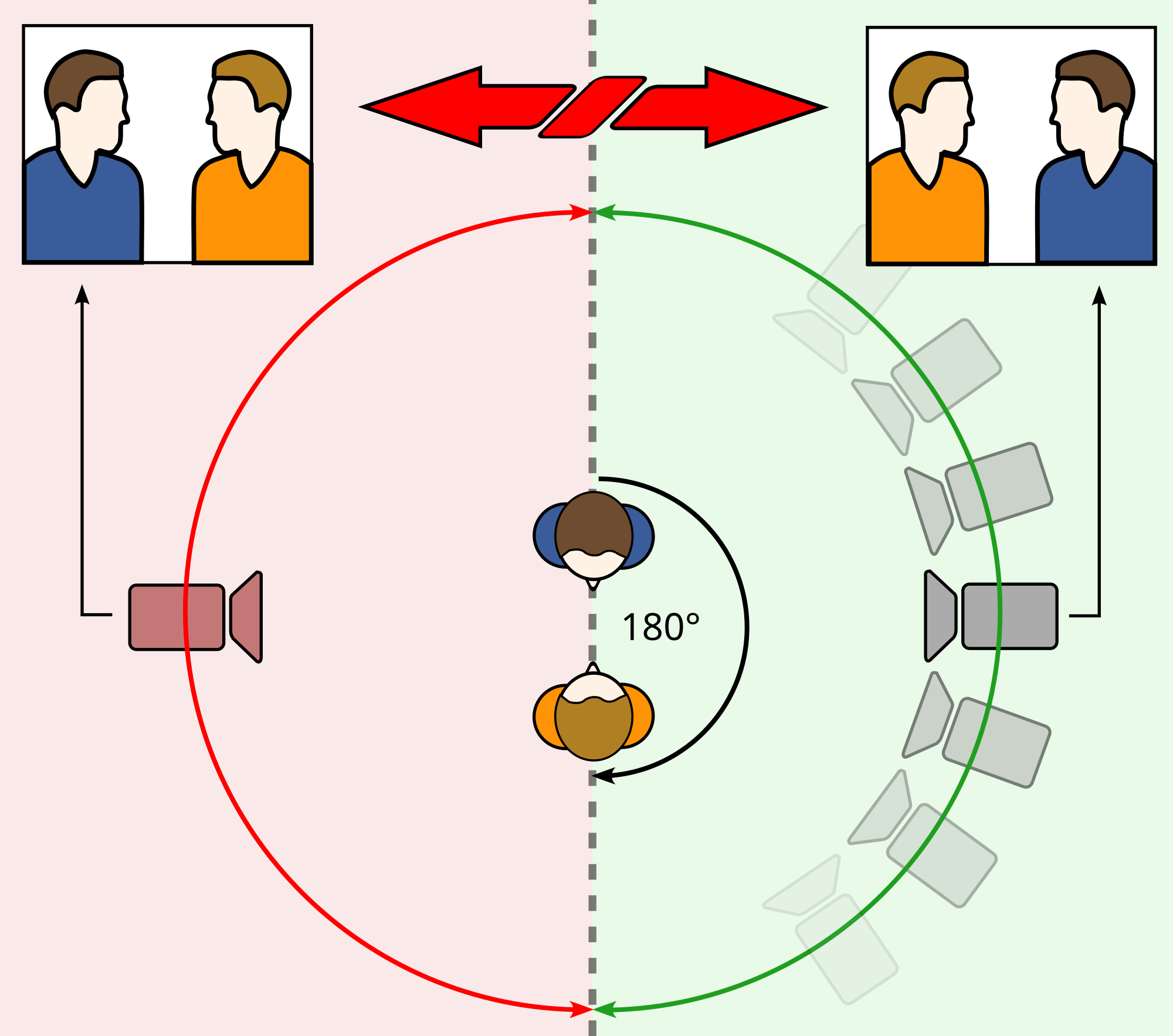
  • The 180 rule

This is a basic guideline about the on-screen relationship between a character and another character or object within a scene.  To understand the 180 rule and to apply film making you need to imagine a line which cuts the scene in half. Similar to an axis and by keeping the camera on one side of this axis for every shot in the scene it creates continuity.


  • Match on Action (cutting on action)

This is where the editor cuts from one shot to another that matches the first shot's action. It looks as if they had been filmed all at the same time but in fact they may have actually been shot hours apart from each other. This creates continuity because it all flows well when edited together. To prevent the audience from noticing the editing the editor creates a “visual bridge” which is designed to distract them while watching so they are concentrating on something other than the editing.


  • 30 degree rule

This is a simple rule that all film makers abide by. The camera shouldn’t go within 30 degrees between shots of the same subject occurring in succession. Failure to follow this rule a jump cut occurs which can distract viewers and make them concentrate on filming where they might notice editing as well. Exception can be made through; some films intend to do jump cuts to create a certain mood.


  • Shot reveres shot

This is where one character is shown looking at someone else, and then the other character is shown looking back at the first character as if they are having a conversation.

                                              
  • Rule of thirds
This is when the frame is cut up using 4 invisible lines creating 9 sections which create reference points which act as guides for framing the image. So you know where to place certain features.